RIVISION / Human eye and colorful world.
Human Eye
Human eye
The human eye is a spherically shaped sense organ(diameter about 2.4 cm) that gives the sense of sight and helps us perceive colours and depth. Our eye acts like a lens and both of our eyes provide binocular vision, the ability to see 3D objects.
How do we see
The eye acts like a lens, where light enters after reflection from objects, through it and forms an image on a light-sensitive membrane which generates electrical signals that are sent to the brain for interpretation via optic nerves.

Structure of eye
The eye structure can be broadly classified as:
- External structure: Sclera, Conjunctiva, Iris, Pupil and Cornea.
- Internal structure: Retina, Lens, Aqueous humor, Vitreous humor and optic nerve.

Eye mechanism
The ciliary muscles change the curvature of the eye by adjusting the focal length. When it contracts, the lens becomes thick → f decreases. When it relaxes, the lens becomes thin → f increases. The pupil regulates the amount of light entering the eye which forms the image on the retina.
Cornea
The cornea is the transparent front part of the eye that covers the iris, pupil, and anterior chamber. The cornea, with the anterior chamber and lens, refracts light, with the cornea accounting for approximately two-thirds of the eye's total optical power. It helps shield the eye from germs, dust and other harmful matter. The cornea shares this protective task with the eyelids, the eye socket, tears, and the sclera. The cornea acts as the eye's outermost lens. It functions like a window that controls and focuses the entry of light into the eye.
Aqueous humour
The fluid located at the anterior and posterior chambers of the eye that helps to maintain the shape of the eye and structure of the lens is called Aqueous humour.
Pupil
The pupil is in the centre of the iris. The iris contracts and dilates involuntarily and changes the size of the pupil. The whole job of the iris and pupil is to control the amount of light that gets into the eye. It's called a pupillary reflex, and you have probably noticed that a person's pupils are smaller in bright light and bigger in low light.
Crystalline lens
Our eye lens is a double convex lens which helps to adjust the focal length required to clearly focus on objects at various distances.

Retina
The retina is the screen where the inverted image gets formed. It is a delicate membrane with a large number of photosensitive cells called rods and cones which transmit the light into chemical and electrical pulses.
Iris
- Iris is a dark muscular diaphragm that controls the size of the pupil. It can widen or close the pupil depending on the brightness of the surroundings.
- Iris of different people may be of different colour.
Optic nerves
- The optic nerve transmits the electrical signals from the eye to the brain.
- Also known as the second cranial nerve.
Rod cells and cone cells
These cells are photosensitive cells that help us see in the dark or in bright surroundings. Cones help us to see colours in bright surroundings while rods help us adjust the vision in dim light or darkness.

Power of Accommodation and Defects
Power of accommodation
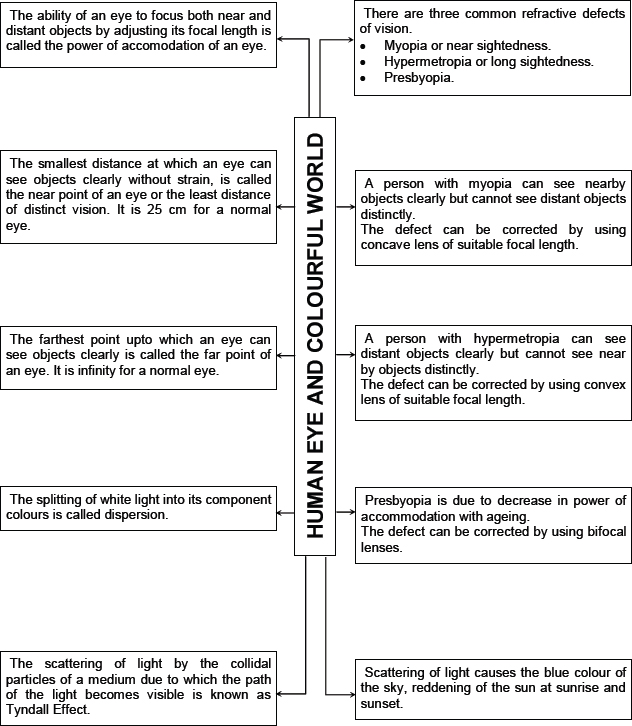
The process by which the ciliary muscles change the focal length of an eye lens to focus distant or near objects clearly on the retina is called the accommodation of the eye. However, the focal length cannot be changed beyond a certain limit.
Near point & far point
- The minimum distance at which an object can be seen most distinctly without strain is called the least distance of distinct vision. It is also called the near point of the eye. It is about 25 cm for a normal human eye.
- The farthest point up to which the eye can see an object clearly is called the far point of the eye. The farthest point for a normal eye is infinity.
Defects of vision and their correction
An eye is said to be suffering from a defect when it cannot focus the image of objects at distances from infinity to near point of a normal eye.
Myopia and its correction
Myopia is also known as nearsightedness. A person with myopia can see nearby objects clearly but cannot see distant objects distinctly. Under myopic conditions, the image is formed in front of the retina.

Correction: A concave lens with suitable (-ve) power will focus the image on the retina.
Hypermetropia and its correction
Hypermetropia is also known as farsightedness. A person with hypermetropia can see distant objects clearly but cannot see nearby objects distinctly. Arises due to long focal length.

Correction: A convex lens with suitable (+ve) power will focus the image on the retina.
Presbyopia and its correction
Presbyopia is caused when the eye muscles gradually weaken with age, causing the range of accommodation to decrease. People with this defect cannot bring near or far objects into focus.
Correction: Bifocals
Correction: Bifocals
Cataract
Sometimes the crystalline lens becomes milky for the aged people which impair vision partially or completely. This condition is called cataract and can be fixed by a surgery.

Astigmatism
- A condition in which there exists an imperfection in the curvature of the eye.
- Correction: Eyeglasses, contact lenses, surgery.

Refraction and Dispersion of Light Through Prism
Refraction of light through a prism
- The angle between the 2 lateral faces of the prism is called angle of the prism.
- Light changes speed when entering one medium from another, which causes it to enter at a different angle.
- The degree of bending depends on (i) angle of the prism (ii) Snell’s Law.
- Deviation angle: the shape of the prism makes the emergent ray bend at an angle to the direction of the incident ray. This angle is known as deviation angle.

Dispersion of white light by glass prism
- White light is a combination of seven component colours and each colour is refracted at a different extent when passed through a prism.
- Different colours correspond to different indices of refraction and wavelengths which imply different speeds.Therefore each colour or wavelength is refracted at different degrees.
- A second prism can recombine the component colours to recreate white light again.

Be More Curious!
Rainbow
A natural spectrum appearing in the sky due to the dispersion of light through a water droplet is known as a rainbow. These water droplets act like small prisms which splits sunlight into its component colours. Light enters the droplet and is reflected from the back of the drop. This reflected ray refracts again when it comes out, as it moves from water to air.

Atmospheric Refraction
Atmospheric refraction
Atmospheric refraction is the deviation of light or other electromagnetic waves from a straight line as it passes through the atmosphere due to the variation in optical density of air. The optical density of air varies with height.
Twinkling of stars
Starlight on entering the earth’s atmosphere undergoes refraction continuously in different layers of varying densities before it reaches earth. Hence it appears to shimmer as the light passes through varying densities and refractive indices.
Advanced sunrise and delayed sunset
The sunrise is advanced due to atmospheric refraction of sunlight. An observer on the earth sees the sun two minutes before the sun reaches the horizon. A ray of sunlight entering the earth’s atmosphere follows a curved path due to atmospheric refraction before reaching the earth.This happens due to a gradual variation in the refractive index of the atmosphere. For the observer on the earth, the apparent position of the sun is slightly higher than the actual position. Hence, the sun is seen before the sun reaches the horizon.Increased atmospheric refraction of sunlight occurs also at the sunset. In this case, the observer on the earth continues to see the setting sun for two minutes after the sun has dipped below the horizon, thus delaying the sunset.

Scattering of Light
Scattering of light
- It is the deflection of a ray from its straight path by irregularities in the propagation medium or at the interface of the different media.
- Scattering depends on the wavelength and frequency of the light and the size of particles in the medium.

Wavelength of visible light
Visible light corresponds to a wavelength range of 400 - 700 nanometers (nm) and a colour range of violet to red. The human eye is not capable of "seeing" wavelengths outside the visible spectrum.

Tyndall effect
Scattering of light through colloidal particles in suspension is called Tyndall Effect. E.g sunlight entering through a small hole in a room full of smoke, or through a canopy. Colour of scattered light depends on the size of the particles. Fine sized particles scatter mainly blue light.

Why is the colour of clear sky blue
Blue colour gets scattered more easily than a red light or any other colour because of its shorter wavelength. Hence the sky appears blue for vast portions of the day.
Colour of the sun at sunrise and sunset
During sunrise or sunset, the apparent position of the sun is near the horizon. Here most of the blue light or shorter wavelengths get scattered away by particles. The light that reaches our eyes is of longer wavelengths and hence has a reddish colour.

Comments
Post a Comment